Text Size
Default size
🏠 Home 🔑 Log in

Urban Runner

UR BULLETIN

Articles, updates and musings from the Urban Runner crew.

The Cushioning Paradox: Why More Foam Isn't Always Better

Coach Rak · 29 April 2026 · 3:16pm

The Cushioning Paradox: Why More Foam Isn't Always BetterFor decades, the running industry has promised that more foam equals…

❤ 1 💬 0

The Cushioning Paradox: Why More Foam Isn't Always Better


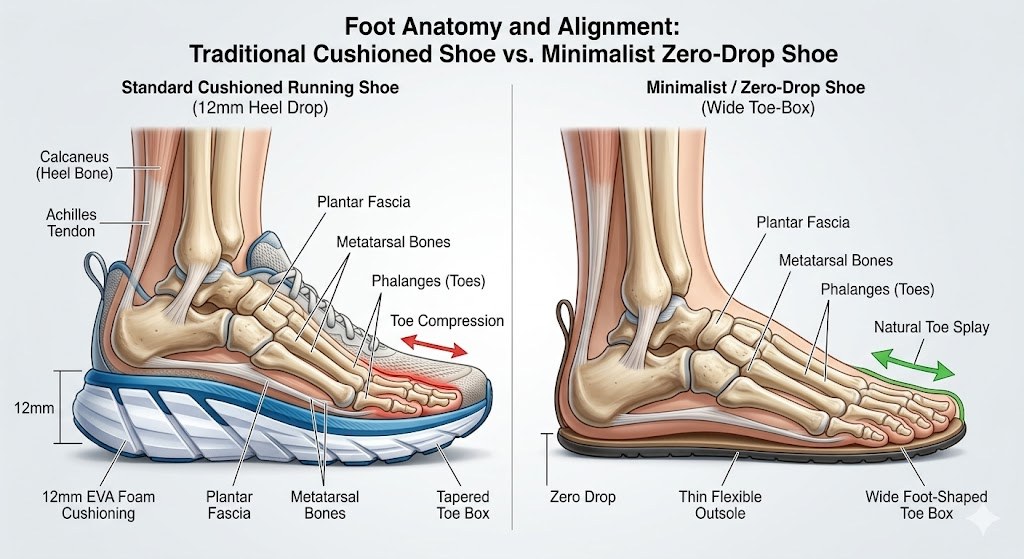
For decades, the running industry has promised that more foam equals fewer injuries. We've been told that thick midsoles and steep heel drops are essential to prevent stress fractures. But at UR, we're looking at the facts: "cushioned" doesn't always mean "safe."


The Myth of Impact Protection

High-cushion shoes are designed to absorb shock, but they often backfire. When you have a thick wedge of foam under your heel, your brain receives a "safe" signal that encourages a heavy heel strike. This leads to overstriding—landing with your foot too far in front of your body—which actually increases the risk of injury.


According to the 'Older Yet Faster' philosophy, this creates a major issue with Muscle Loading. In traditional shoes, your foot becomes a "passenger." Because the shoe does the work, your foot muscles weaken, and your legs lose their ability to act as natural springs. Instead of your tendons elastically absorbing energy, the impact is forced upward into your knees and hips.


The Proprioception Problem

Proprioception is your body's "sixth sense"—the ability to feel where your limbs are in space.

Excessive cushioning acts like noise-canceling headphones for your feet. It muffles the feedback from the ground, making it harder for your nervous system to "read" the surface. Without this clear signal, your gait becomes sloppy. In contrast, a flat, minimalist shoe allows your toes to splay and your brain to communicate clearly with the ground, encouraging a precise midfoot strike directly beneath your center of gravity.


Relearning to Run

Moving away from high-cushion shoes isn't about an overnight change; it's about rebuilding the relationship between your feet and the pavement. By reducing the "noise" of excessive foam, you allow your body to rediscover its natural, efficient gait.

Ready to find your natural stride? Transitioning requires a shift in technique to protect unconditioned muscles. Join us at our next Beginner's Workshop to learn the drills and mechanics needed to run lighter, stronger, and "Older Yet Faster."

Comments

Your 12-Week Plan for Transitioning to Minimalist Shoes

Coach Rak · 22 April 2026 · 3:16pm

One of the most common questions we get at Urban Runner is: "I want to try minimalist shoes — where do I start?" The honest…

❤ 0 💬 0

One of the most common questions we get at Urban Runner is: "I want to try minimalist shoes — where do I start?" The honest answer is: slowly. Very slowly.


Your feet have likely spent years in heavily cushioned, elevated-heel shoes. The tendons, ligaments, and small intrinsic muscles of the foot are almost certainly underdeveloped as a result. Rushing the transition is the single biggest mistake new barefoot runners make — and it's why so many end up with calf strains or Achilles issues within the first few weeks.


The Golden Rule: 10% Per Week

Whatever mileage you currently run, replace no more than 10% of it with minimalist miles in week one. If you run 30km a week, that's 3km in your new shoes. It sounds almost insultingly low. Do it anyway.

Add another 10% each week — and if anything feels sore or tight, hold your mileage flat for a week before progressing. The Achilles tendon adapts slowly. Respect that.


Weeks 1–4: Ground Work

Start every minimalist session on grass. Grass is forgiving, gives you instant feedback about foot placement, and lets you go briefly barefoot without wrecking your soles. We do this at Valentine's Park every week — it's not just a drill, it's the foundation.

Focus on landing with your foot beneath your hips, not out in front. If you can hear your footstrike, you're overstriding. Aim for quiet feet.


Weeks 5–8: Road Kilometres

Gradually shift minimalist mileage onto pavement. Keep cadence high — aim for 170–180 steps per minute. A metronome app helps enormously here. Short, quick strides are far kinder to the foot than long, slow ones.

Introduce foot strengthening work alongside your runs: single-leg calf raises (3×15 each side), toe spreading on the floor for 60 seconds, and barefoot walking around the house. None of this is glamorous. All of it works.


Weeks 9–12: Building Confidence

By now your feet should feel noticeably stronger. Your old cushioned shoes will probably feel strange — too tall, too stiff. That's a good sign. Increase minimalist mileage to 50–70% of your weekly total and run your first full parkrun or tempo session in them.


Twelve weeks won't complete the transition — that takes the better part of a year for most people. But it gives your feet enough adaptation to know whether minimalist running is for you. For most of us at UR, once you've felt the difference, there's no going back.

Comments

Why We Do Barefoot Grass Drills (And What They're Actually Teaching Your Body)

Coach Rak · 15 April 2026 · 3:16pm

If you've been to a Thursday track session, you'll have seen us kicking our shoes off and doing laps of the infield grass. It…

❤ 1 💬 0

If you've been to a Thursday track session, you'll have seen us kicking our shoes off and doing laps of the infield grass. It probably looks a bit odd from the outside. Here's what's actually happening.


Grass as a Teaching Surface

Grass gives you something tarmac can't: immediate, honest feedback. When you land heavily on your heel on grass, you feel it — there's no foam buffer to mask a bad footstrike. Your nervous system gets a clear signal, and over time it learns to seek the quieter, softer landing that comes from a midfoot strike under your centre of mass.

This is proprioception in action. The thousands of nerve endings on the sole of your foot are doing exactly what they were designed to do. The more often you give them a clear signal, the better your running economy becomes — even when you put your shoes back on.


What the Drills Are Building

The barefoot drills we run through — high knees, A-skips, strides — aren't just warm-up filler. Each one is targeting a specific neuromuscular habit:

High knees train hip flexor drive and forward lean without overstriding.

A-skips groove the cycling action of the foot beneath the hip — the exact motion you want in a fast midfoot stride.

Barefoot strides (30–50m at 80% effort) let you experience genuine elastic rebound from the Achilles and calf. The foot lands, the arch loads like a spring, and energy returns on push-off. In thick shoes, this mechanism is partially bypassed. Barefoot, you can actually feel it working.


The Long Game

Coaches who work with elite distance runners often point to the East African training model — enormous volumes of barefoot running on dirt roads and grass in childhood. Those athletes arrive in elite sport with feet that are mechanically exceptional: strong arches, powerful toe flexors, and Achilles tendons that function as highly efficient springs.

We're not going to replicate that with twenty minutes on the infield every Thursday. But we're pointing in the right direction. Every barefoot session is making a small deposit into an account that pays out in better form, fewer injuries, and — eventually — faster times.


So next time I ask you to take your shoes off, don't worry about what people on the track think. They'll come round eventually.

Comments

The Five Foot Exercises Every Minimalist Runner Should Be Doing

Coach Rak · 5 April 2026 · 3:16pm

Strong shoes have been doing your feet's job for years. Here's how to give that job back.When runners transition to minimalist…

❤ 0 💬 0

Strong shoes have been doing your feet's job for years. Here's how to give that job back.


When runners transition to minimalist footwear, the most common stumbling block isn't technique — it's foot and calf strength. The small intrinsic muscles of the foot, the plantar fascia, and the Achilles tendon all need time to catch up with the new demands being placed on them. These five exercises accelerate that process. Do them daily, not just on run days.


1. Single-Leg Calf Raises

Stand on one foot on the edge of a step, heel hanging off. Lower slowly (3 seconds down), pause at the bottom, then rise onto your toes. 3 sets of 12–15 each side. This is the single most important exercise for Achilles tendon resilience. If it feels easy, add load — hold a dumbbell or a backpack.


2. Toe Spreading

Sit with bare feet on the floor. Consciously spread all five toes as wide as possible and hold for 5 seconds. This sounds trivial. Try it and see how limited your range is after years in narrow toe boxes. 3 sets of 10 reps, twice a day. Progress to standing, then to single-leg balance with toes spread.


3. Short-Foot Exercise

Sitting or standing, draw the ball of your foot towards your heel without curling your toes. You're trying to shorten and dome the arch. Hold 5 seconds. This activates the intrinsic foot muscles that conventional shoes switch off. 3×10 each foot. It's harder than it sounds the first time — that's the point.


4. Barefoot Single-Leg Balance

Stand on one bare foot for 60 seconds. When that's easy: close your eyes. When that's easy: stand on a folded towel or a balance board. Your ankle stabilisers and foot muscles are working constantly during this. It directly transfers to the micro-adjustments your foot makes with every stride on uneven ground.


5. Marble Pick-Ups

Scatter a handful of marbles (or small pebbles) on the floor and pick them up with your toes into a cup. Old-school physio trick — it isolates the toe flexors and intrinsic muscles that rarely get trained in conventional footwear. One minute per foot is enough.


None of these require gym equipment. All of them can be done while watching TV or waiting for the kettle. The foot is trainable — it just needs the opportunity. Give it one.

Comments

Stack Height, Drop, and the Numbers on Your Shoe Box — Explained

Coach Rak · 25 March 2026 · 3:16pm

Walk into any running shop and you'll be confronted with a wall of numbers: 10mm drop, 28mm stack, 4mm lugs. Most salespeople…

❤ 0 💬 0

Walk into any running shop and you'll be confronted with a wall of numbers: 10mm drop, 28mm stack, 4mm lugs. Most salespeople can't explain what they mean. Here's a plain-English breakdown.


Heel-to-Toe Drop

Drop (sometimes called "offset") is the difference in height between the heel and the ball of the foot inside the shoe. A traditional trainer typically has 10–12mm of drop. A zero-drop shoe has 0mm — your heel and forefoot sit at exactly the same height, as they would on flat ground.

Drop is the number that matters most for running mechanics. High drop tilts you forward slightly from the ankle and encourages your foot to land heel-first. Zero drop encourages a more neutral foot position and tends to promote a midfoot or forefoot strike — though technique still matters more than the shoe.


Stack Height

Stack height is the total thickness of material between your foot and the ground — midsole plus outsole. A maximalist shoe like a Hoka Bondi has a stack height of around 36–40mm. A true minimalist shoe sits at 6–10mm. Zero-drop Vibram FiveFingers are around 3–4mm.

Lower stack means more ground feel and more demand on your foot's own shock-absorbing structures. Higher stack means more protection but less feedback. Neither is universally better — it depends on where you are in your strength journey.


Toe Box Width

This one rarely gets a number but deserves attention. Most conventional shoes taper the toe box to a point that forces the toes together. A wide toe box allows the toes to splay naturally on landing, which activates the small muscles of the foot and improves balance and propulsion. Look for shoes where the widest point of the shoe matches the widest point of your foot, not the shoe's aesthetic.


What to Look For

If you're new to minimalism, start with a 4–6mm drop and a moderate stack (around 18–22mm). This is enough of a change to start re-educating your gait without shocking your Achilles. Brands like Altra, Topo, Xero, and Vivobarefoot all make options across this range.

Avoid going from a 12mm drop shoe directly to zero-drop. Your calf and Achilles need several months to adapt. The shoe box numbers tell you where a shoe sits on the spectrum — your job is to move along it gradually, not jump to the far end.

Comments

180 Steps Per Minute: The Cadence Principle and Why It Changes Everything

Coach Rak · 12 March 2026 · 3:16pm

In 1984, sports scientist Jack Daniels observed elite distance runners at the Los Angeles Olympics and noticed something…

❤ 0 💬 0

In 1984, sports scientist Jack Daniels observed elite distance runners at the Los Angeles Olympics and noticed something striking: nearly all of them — regardless of pace, height, or event — were running at around 180 steps per minute. That observation became one of the most influential ideas in running coaching, and for good reason.


Why Cadence Matters

Most recreational runners take between 150 and 165 steps per minute. The difference between that and 180 isn't just a number — it changes the entire geometry of your stride.

At a lower cadence, you tend to overstride: your foot lands in front of your centre of mass, creating a braking force with every step. Think of it as repeatedly running slightly into a wall. At 180spm, your stride shortens, your foot lands closer to beneath your hips, and that braking force largely disappears. You're no longer fighting the ground — you're using it.


The Barefoot Connection

This is where minimalist running and cadence intersect. When you run barefoot or in low-stack shoes, your body naturally gravitates toward a higher cadence and shorter stride — because a heavy heel strike on a hard surface with no cushioning is immediately uncomfortable. The shoe, in other words, has been masking a mechanical problem.

Increasing cadence in conventional shoes helps. Running in minimalist shoes with increased cadence is where the real adaptation happens — because the feedback loop is honest.


How to Increase Your Cadence

Don't try to jump to 180spm overnight. Aim for a 5% increase over four to six weeks — that's typically 8–10 additional steps per minute.

The easiest method: download a metronome app, set it to your target cadence, and run to the beat for one 10-minute segment of each run. Focus on quick, light turnover rather than pushing off harder. Think of your feet as wheels spinning, not pistons pounding.

A GPS watch with a cadence metric helps too — most of the major brands measure it. Check your average cadence at the end of each run and track it over weeks, not days.


A Note of Caution

180spm is a useful target, not a law. Taller runners often run efficiently at 170–175spm. The goal isn't to hit a magic number — it's to eliminate the braking overstride. If your cadence is rising and your easy runs feel genuinely lighter, you're moving in the right direction.

Comments