Theme
Text Size
Default size
🏠 Home 🔑 Log in

Our Philosophy

OLDER YET FASTER

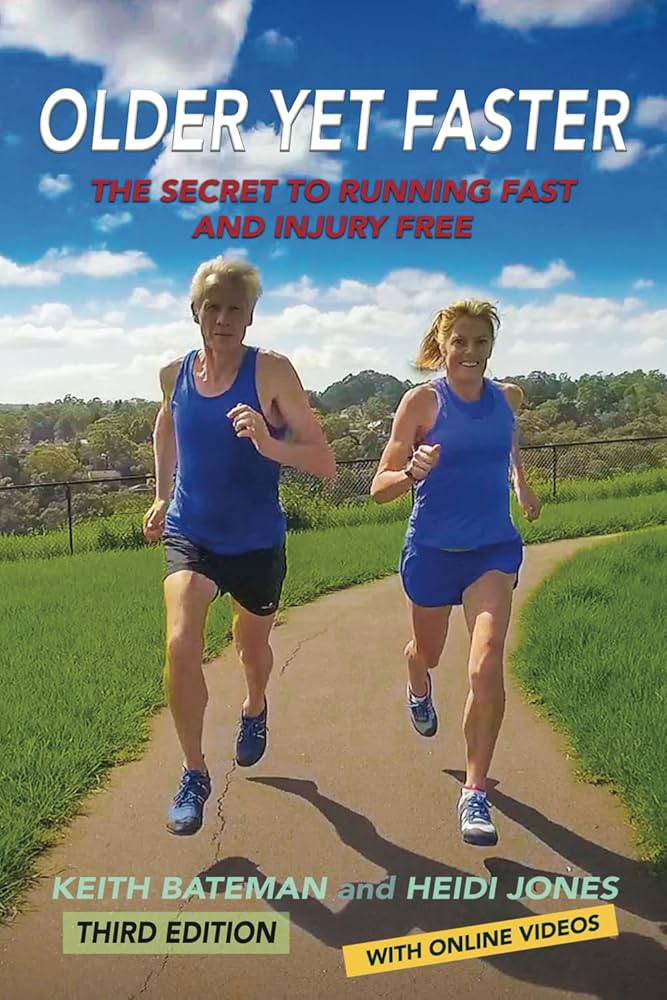
Older Yet Faster — The Secret to Running Fast and Injury Free by Keith Bateman and Heidi Jones
Older Yet Faster
The Secret to Running Fast and Injury Free
By Keith Roland Bateman & Heidi Jones
📦 Buy on Amazon UK
🏃 OYF at Urban Runner

Older Yet Faster is the book that Urban Runner is built on. When Coach Rak discovered OYF, it changed everything — not just how he runs, but how he coaches, what footwear he recommends, and the entire philosophy behind Monday track sessions at Ashton Sports Ground.

Every drill we do at track, every conversation about foot strike and cadence, every recommendation to ditch the cushioned trainers — it all traces back to Keith and Heidi's work. The minimalist shoe criteria we use, the 180 BPM cadence target, the focus on form over mileage — OYF.

If you want to understand why we train the way we do, this is the book. It is the most important thing any Urban Runner member can read. We recommend every member gets a copy.

Older Yet Faster is a comprehensive manual for teaching runners of any age or ability how to transition to efficient, natural running — and how to do so without getting injured along the way. Now in its fourth edition, it has been translated into multiple languages and used by runners, coaches, podiatrists, and medical professionals worldwide.

The central idea is both radical and simple: most running injuries are caused not by running itself, but by poor technique and inappropriate footwear. Fix the technique and the footwear, and the injuries largely disappear — often permanently. More remarkably, the authors show that improving your technique can make you faster as you get older, not slower.

The book combines Keith's six technique-change lessons with Heidi's foot strengthening and rehabilitation programme to give runners a complete, step-by-step system for transformation. Both elements are essential — technique change without foot strengthening leads to injury; foot strengthening without technique change gives you stronger feet but the same inefficient movement patterns.

"If you can't explain it simply, you don't understand it well enough."

— Albert Einstein, quoted by Keith Bateman in OYF

OYF is not a fad or a shortcut — it is a complete rethinking of how humans are designed to move. These are the principles at the heart of the system:

01
Land close to under your hips
Your foot should strike the ground directly beneath your centre of mass — not in front of it. Overstriding is the single most common cause of running injuries and inefficiency.
02
Shoes are the problem
Modern cushioned, elevated shoes with arch support actively prevent natural foot movement. They weaken the intrinsic muscles of the foot and force a heel-strike pattern that the body wasn't designed for.
03
Minimalist footwear
A minimalist shoe must be flat (zero heel drop), flexible, wide in the toe box, and lightweight with no arch support. This allows the foot to function as nature intended — as a sophisticated spring.
04
High cadence
A higher step rate (targeting around 180 BPM) means longer strides with increased candance, less ground contact time, and dramatically reduced impact forces on every landing.
05
Strengthen the feet
Decades of supportive footwear have left most runners with weak, dysfunctional feet. Heidi's strengthening programme rebuilds the intrinsic foot muscles from the ground up — a prerequisite for safe minimalist transition.
06
Technique over mileage
Good form with low mileage beats poor form with high mileage every time. Keith ran as little as 15–20 km per week while breaking world records in his 50s. Quality of movement is everything.
07
Full body posture
Running form is whole-body. A neutral spine, open hips, relaxed shoulders, and a forward lean from the ankles all contribute to efficiency. Heidi's physics-based analysis of posture is a revelation for most runners.
08
Transition slowly
The most common OYF mistake is going too fast. Calf tightness, Achilles soreness, and plantar fasciitis are all signs of transitioning too quickly. The system works — patience is essential.
Keith Bateman
Competitor & Running Coach
Keith's story is the proof of concept for everything OYF teaches. From the age of 45 his running times began to improve — dramatically and consistently — as he refined his technique. At 55 years, 8 months and 27 days he became the oldest person ever to break 32 minutes for 10 kilometres. His records in the 55-age-group were faster than those he had set at 45.
1500m 4:12.35 1 mile 4:35.04 3000m 8:56.80 5000m 15:29.7 10000m 31:51.86
Five World Records in the 55-age-group, set in the space of nine months. 38 State Records. 15 Australian age-group records. All achieved through technique change, not extra mileage.
Heidi Jones
Podiatrist & Competitor
Heidi is a former youth state champion — running 10 miles in 58:13 and 10 kilometres in 33:40 at the age of 17. She became a podiatrist specifically to fix running injuries, founding Feet On The Move in Bondi, Sydney in 1996.
After finding that orthotics consistently failed her patients over the long term, Heidi developed her own foot-strengthening programme as an alternative. Her physics-based approach to posture, foot mechanics, and footwear is unlike anything else in the field — and it works. Her section of the book is as important as Keith's lessons.

OYF is structured as a step-by-step system. The early chapters explain the theory — why injuries happen and how running biomechanics work. Then Keith's six lessons take you through the technique change process one step at a time, supported throughout by Heidi's strengthening exercises.

01–03
Understanding injuries & running mechanics
Why most injuries happen, the physics of running, and how good technique prevents damage
04–09
Keith's Six Lessons — the OYF technique system
Step-by-step technique change from the basics through to refining and race application. Supported by online videos
10–11
Heidi's Strengthening & Rehabilitation programme
The foot-strengthening exercises that make the technique change possible and sustainable
12–13
Managing the changes & Rehabilitation
What to expect during transition and what to do if you get injured along the way
14
Footwear
Why your shoes matter more than almost anything else, and exactly what to look for in a minimalist shoe
15–16
Body changes & General tips
How your body shape will change as you adopt natural running technique, plus common traps to avoid
App.
For Coaches, For Podiatrists & Advanced Strengthening
Three detailed appendices for professionals and serious runners wanting to go deeper

Why Age is Not the Enemy

The title says everything. We are conditioned to believe that running gets harder as we age — that times slow, injuries accumulate, and eventually we have to accept decline. OYF challenges this narrative completely.

Keith's records were set in his mid-fifties. Not in spite of his age — but in part because of the wisdom that came with it. He had the patience to change his technique properly, the discipline to strengthen his feet, and the experience to train smart rather than just hard. His improvements came from technique change, not from running more miles.

The OYF system applies equally to a 20-year-old new to running and a 60-year-old carrying a decade of niggles. The body responds to good movement at any age. You are never too old, too slow, or too far gone to run well.

"There is no reason why your running cannot be injury free — if you follow the principles in Keith's Lessons and use Heidi's Strengthening Program."

— Stuart Greaves, Foreword to Older Yet Faster

Buy Your Copy

OYF is available in print and as an ebook. The print and ebook editions include access to Keith's online lesson videos and Heidi's exercise videos — a crucial part of the system. The videos make the technique changes far easier to understand and implement than words alone. An audiobook is in the works!

Available in English (with French and Spanish editions also published). Now in its fourth edition with updated content, advanced strengthening exercises, and new insights into modern running footwear including carbon-plate super shoes.

📦 Buy on Amazon UK 🌐 Official OYF website
Live Q&A Sessions
🎥
Keith Bateman — Live Q&A #1
Barefoot running, minimalist shoe choice, technique cues, injury recovery, and training at 68.
Watch →
🎥
Keith Bateman — Live Q&A #2
Race shoe choice, super shoes vs natural running, the rebound feeling, stride length gains, and calf soreness in transition.
Watch →
🏃 Form Tips Library 👟 Shoe & Sandal Guide ✅ Track Legal Shoes
← Back to Our Philosophy